Chapter 16: Data representation
Data types
Built-in data types
- the
programming languagedefines the range of possible values that can be assigned to a variable when its type has been chosen. - the programming language defines the operations that are available for manipulating values assigned to the variable.
User-defined data types
Non-composite data types
- does not involve a reference to another data type
Enumerated data type
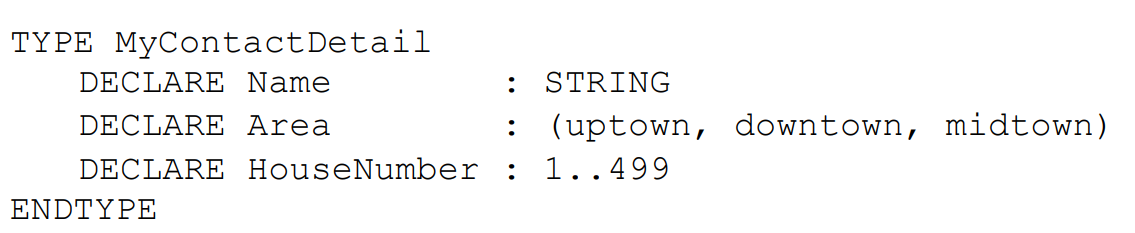
- a non-composite user-defined data type for which the definition identifies all possible values
- a pseudocode example
Composite user-defined data types
- Record
- collection of related items which may have different data types
- Array
- (Indexed) collection of items with the same data type
- List
- (Indexed) collection of items that can have different data types
- Set
- stores a finite number of different values that have no order // supports mathematical operations
- Class/Structure
- Gives the properties and methods for an object
Pointer data type
Set data type
- It contains a collection of data values.
- There is no organisation of the data values within the set.
- Duplicate values are not allowed.
File organisation
- the content is stored using a specific binary code
- A file is either a text file or a binary file
- The organisation of a binary file is based on the concept of a record
- A file contains records and each record contains fields
Serial files
- In a serial file each new record is simply appended to the file so that the only ordering in the file is the time order of data entry.
Sequential(顺序的) files
- records that are ordered
- there has to be a key field for which the values are unique and sequential but not necessarily consecutive
Direct-access files(Random-access files)
- only that the access can be to any record in the file without sequential reading of the file
- A separate index file is created which has two fields per record. The first field has the key field value and the second field has a value for the position of this key field value in the main file.
Hashing algorithm
- do not have any order
- different key field values can produce the same remainder and therefore the same address in the file
File access
Real number
Floating-point
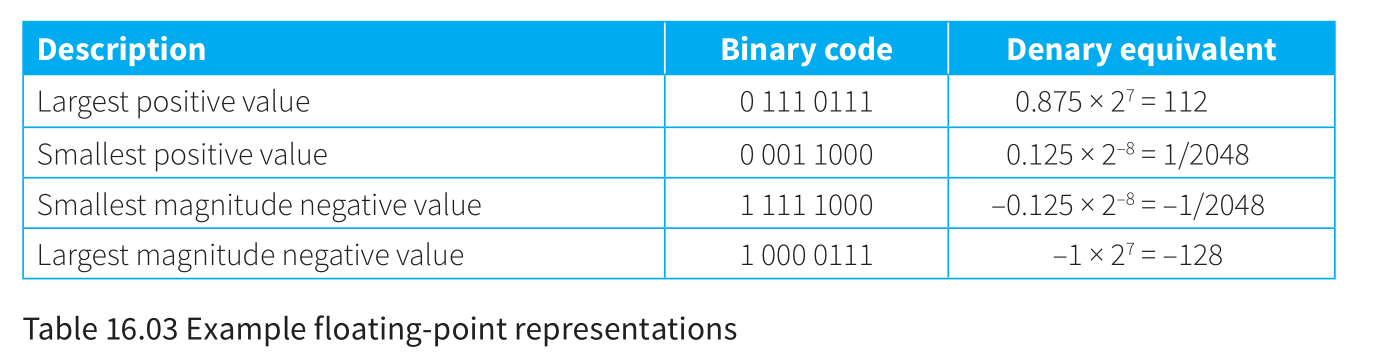
- Floating-point representation: a representation of real numbers that stores a value for the mantissa and a value for the exponent
- example:
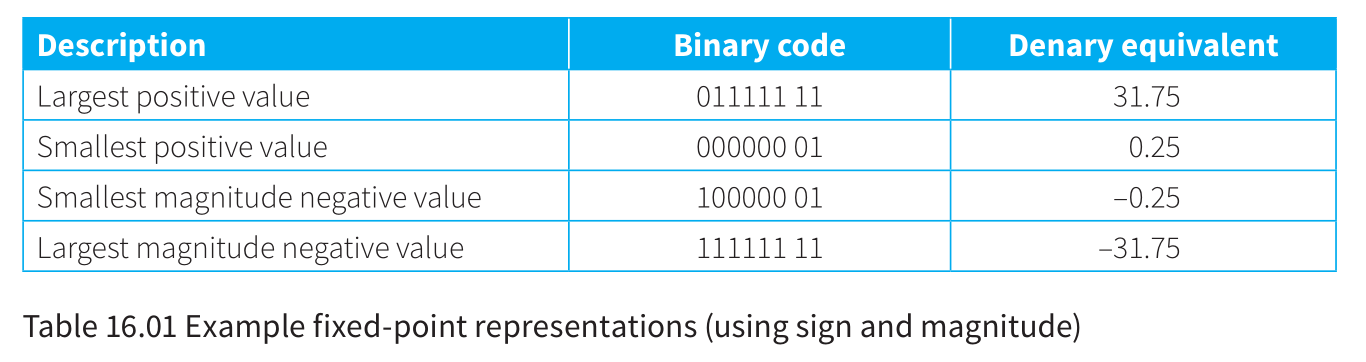
Fixed-point representations
Precision
- the total number of bits to be used and decide on the split between those representing the mantissa and those representing the exponent
increasingthe number of bits for themantissawould givebetter precisionfor a value- leave
fewerbits for theexponent, whichreduces the rangeof possible values
Normalisation
- For a positive number, the bits in the mantissa are shifted left until the most significant bits are 0 followed by 1
- For a negative number until the most significant bits are 1 followed by 0
Conversion of representations
-
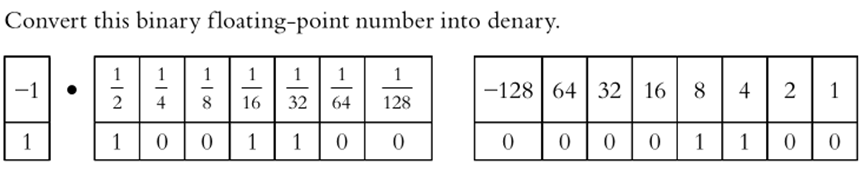
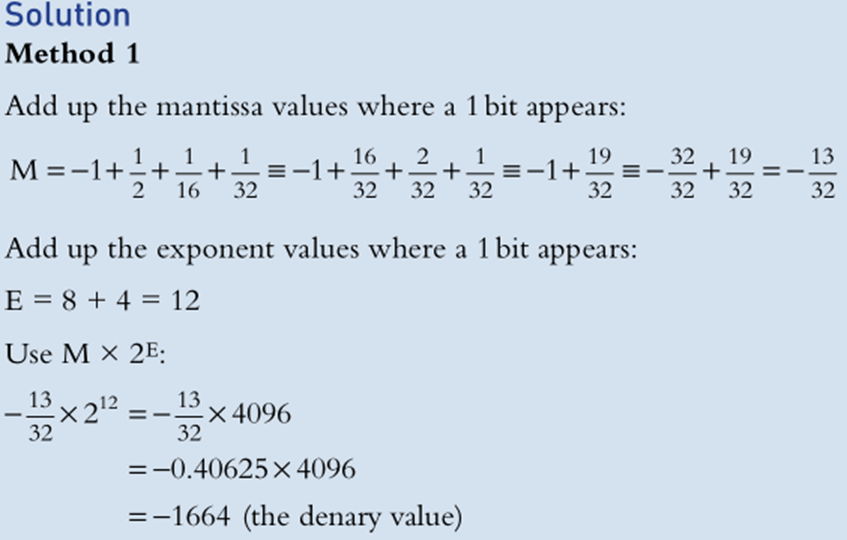
Binary floating number to denary
-
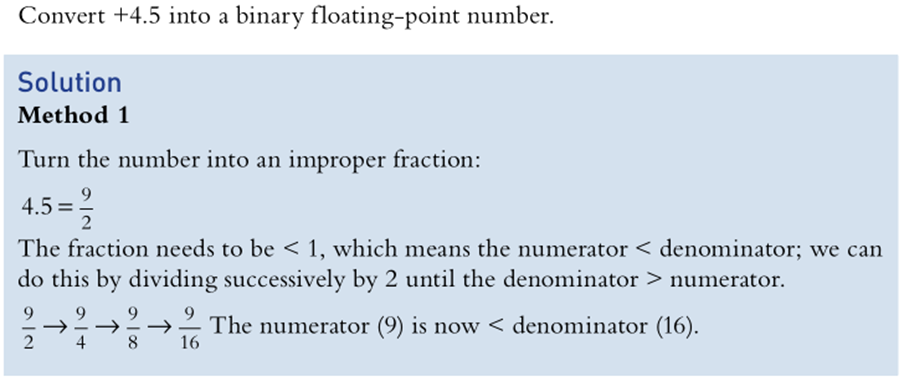
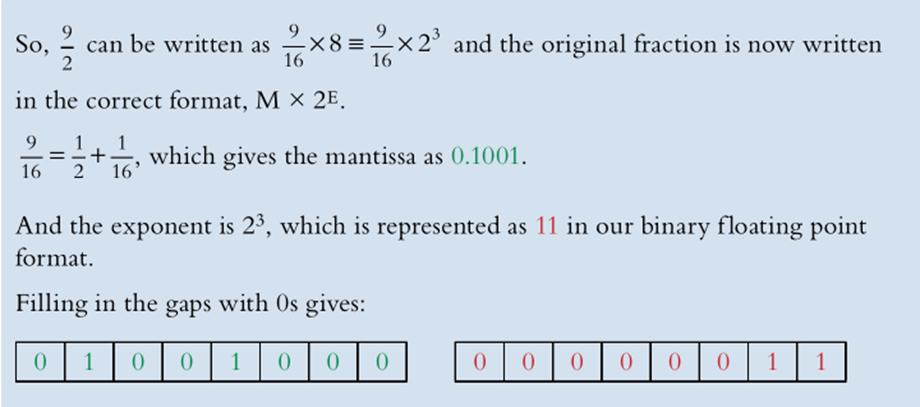
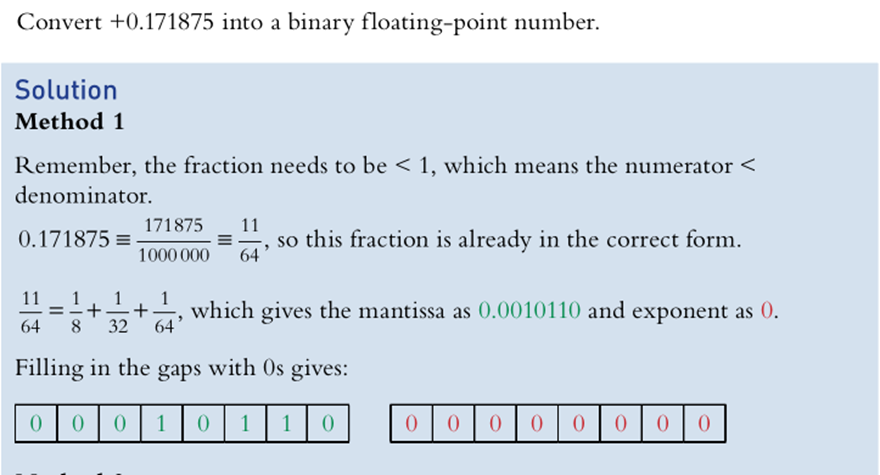
Denary to binary floating number
Problems with using floating-point numbers
- Floating-point numbers are used in extended mathematical procedures involving repeated calculations.
- Rounding errors
- if calculations are repeated enough times
- To avoid, you should increase the precision
- Range of numbers that can be stored
- overflow error condition
- underflow error condition